Embodied spiritual, theological, and philosophical musings on personal and spiritual formation.
Author: John Chang-Yee Lee
I am an ordained Presbyterian Minister of the Word and Sacrament as well as Buddhist and Daoist practitioner. After serving as a chaplain, congregational pastor, and seminary professor, I now serve as a Spiritual Director, Reflective Supervisor and consultant.
The 57th anniversary of John Coltrane’s album A Love Supreme is December 9. I have frequently reflected on my own relationship with this recording since first hearing it. I have been offering spiritual direction for the last few years and have seen how profound Coltrane’s life and this album was for me and many others. I believe exploring Coltrane’s. album may speak to where we are in our own journeys and the experience of saṁvega.
What is Saṁvega?
Thanissiro Bikkhu defines this experience as three clusters of feelings at once:
The oppressive sense of shock, dismay, and alienation that comes with realizing the futility and meaninglessness of life as it’s normally lived;
a chastening sense of our own complicity, complacency, and foolishness in having let ourselves live so blindly;
and an anxious sense of urgency in trying to find a way out of the meaningless cycle.[1]
When my mother was sick for 8 years and eventually died from cancer at 47 years old; when other kids would taunt me with racial slurs on the playground; when walking on the sidewalk and another truck passes me and taps its brakes to slowly make a U-Turn to confront me; when the video replayed the airplanes crashing into the world trade center the same day I began my time as a chaplain in a long-term care facility; and when I was confronted with the realization that I ultimately could not keep my own children and partner completely safe from these dangers of this world; I can clearly recall frequent moments of saṁvega arising in my own experience.
The awareness of this clustered feeling of alienation and futility may be intense or numbingly persistent. It may threaten to lead us to despair, resignation, and/or hedonism in coping with its arising. But there is another way of dealing with it. Buddhism encourages us to notice and become aware of this feeling rather than avoid or separate it from our experience. Saṁvega arises out of compassion and is a natural response to witnessing and experiencing the suffering of the world. This was what Siddhartha Gautama first felt as a sheltered prince upon witnessing a sick person, an elderly man, and a corpse. Rather than desiring things to be different, despairing, or avoiding this feeling, saṁvega can lead us to pursue an answer to this reality. Buddhism doggedly practices with it through letting go of desire and grasping while keeping dukkha (suffering) and impermanence at the forefront.
The Four Sights
Rather than despondency, the counterbalance to saṁvega is pasāda. Bikkhu defines this equally multifaceted emotion as “clarity and serene confidence…that keep saṁvega from turning into despair.”[2] Pasāda is a strong hope, and later confidence, that we’ve found a way to address saṁvega – a way to live that’s not futile or meaningless, but positive, fruitful, helpful, and leads to greater wisdom, peace, and compassion. Pasāda was represented by the renunciate holy man Siddartha Gautama saw amid the impermanence and suffering. This spurred him to begin his own spiritual search which led to him becoming a Buddha (awakened). But what was also true in this story of the Buddha’s pursuit was that there were other methods explored that either didn’t quell the saṁvega or were only temporarily effective. In other words, the pursuit may have bumpy starts, stops, and dead ends along the way.
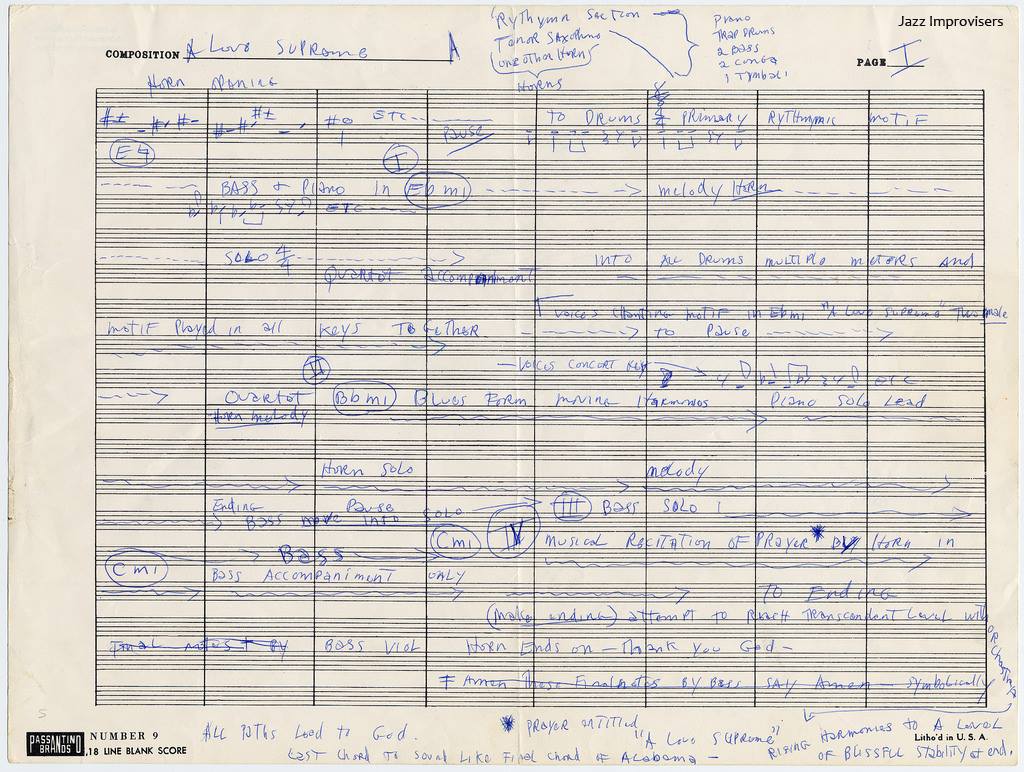
John Coltrane’s album “A Love Supreme” is a modern example of his own journey through saṁvega and pasāda. This album was recorded in one session on December 9, 1964. This four part suite was performed with hardly any sheet music or direction between him and his bandmates McCoy Tyner, Elvin Jones, and Jimmy Garrison. The album is regarded as a proclamation of Coltrane’s spiritual purpose and path through his music. It is celebrated as one of the most important jazz albums and treasured by many as Coltrane’s masterpiece.
From Left to Right: Elvin Jones, McCoy Tyner, John Coltrane and Jimmy Garrision
I was in high school when someone initially recommended I listen to this album, knowing that I was a musician and was also interested in religious and spiritual matters. I am a second generation Asian American who grew up in a place in the U.S. where there were not a lot of other BIPOC people around me. Questions of identity and expression were central within my own life and music with the emotions of anger, sadness, hurt, longing, dissatisfaction, and restlessness often driving this search for meaning and purpose. My own saṁvega was deeply embodied as I desperately searched for the hope of any type of pasāda.
The suggestion to listen to Coltrane, and particularly A Love Supreme, seemed like a healing suggestion more than simply a musical one. Coltrane was relentless in his pursuit of the mastery of his instrument. Coltrane battled addictions that initially soothed his feelings of misery but later became paths of self-destruction. He was raised as a Christian. But by 1964, Coltrane was discovering other religions and practices that expanded his awareness and understanding of what it meant for him to be human.
When I first listened to the album, I didn’t understand it. Honestly, I did not enjoy the experience. I kept jumping between the four tracks, never getting through the entirety of any of them. None of them seemed to speak to me and my experience. I remember thinking there was neither a melody, technique, or rhythm that I could use immediately. I put the album away and didn’t give it much thought.
Many years passed since that initial exposure to Coltrane. My own journey led me to other places around the world, other relationships, and other experiences. With this came exposure to Christian spiritual practices, Zen sitting meditation, and other non-dual exercises. These broadened my understanding of who I am and the varied textures of my own emotional landscape. Now, listening to “A Love Supreme” a second time without an agenda or intention for utility was revelatory. I could hear Coltrane on his own terms.
Coltrane and Saṁvega
There are many potential experiences of saṁvega in Coltrane’s life. John William Coltrane was born in a segregated North Carolina in 1926. In 1938-39, John’s family suffered a series of significant deaths including his aunt, grandfather, grandmother, and his father. All of these deaths devastated the family.[3] It was at this time that Coltrane began taking up the alto saxophone and clarinet. He began his now famous discipline of practicing obsessively “as if [it] would bring his father back, or maybe help him forget his father – as if, succeeding in music, he could restore stability and control to his life.”[4] From these deaths, Coltrane’s family fell into poverty and his mother was forced to move them both to Philadelphia looking for work.
Coltrane then dove into learning and mastering different styles of music and gleaning music theory from a number of different artists. His insatiable curiosity and obsessive practicing reflected his focus on finding an elusive sound and expression.[5] So as not to disturb the neighbors, he would practice late at night by simply imagining the music while fingering the notes on the instrument without blowing into his horn.[6] He would sometimes come off the stage while another member was soloing and go into the bathroom to practice something else he was working on! Yet that same voraciousness was also reflected in other aspects of his life. Coltrane developed a destructive heroin and alcohol addiction that severely curtailed his art.
Coltrane resolved to quit his heroin addiction cold turkey after being fired from Miles Davis’ band. With only his family as support, he fasted and isolated himself in the apartment with no medication or medical intervention. This experience was so devastating, his daughter Syeeda later recalled believing he was going to die that night. After more than a week, he emerged from his room free from his addiction but changed markedly. Even his playing changed significantly from this moment forward.
A Love Supreme – in All 12 Keys
In the liner notes of “A Love Supreme”, Coltrane outlines the impetus for this album stemming from the experience of kicking his addiction.
In the year of 1957, I experienced, by the grace of God, a spiritual awakening, which was to lead me to a richer, fuller, more productive life. At that time, in gratitude, I humbly asked to be given the means and privilege to make others happy through music. I feel this has been granted through His grace. ALL PRAISE TO GOD.
John Coltrane in the Liner Notes of A Love Supreme
In the years leading up to 1964 and this album, it appeared that Coltrane was off heroin and was trying to make sense of his experience in 1957. It was not an easy path or search as Coltrane relentlessly pursued this understanding through his music, expanding his knowledge through albums such as “Giant Steps” and songs such as “A Few of My Favorite Things” and “Mississippi”; looking for teachers and spiritual guides such as Miles Davis, Thelonious Monk, Cyril Scott and Hazrat Inayat Khan. He began exploring Buddhism and Hinduism. All of this journey, the initial suffering and understanding as well as searching and insight, led to the creation of “A Love Supreme.” Alice Coltrane recalls the time when John came down from the attic after many days with the idea for the album:
It was like Moses coming down from the mountain, it was so beautiful. He walked down and there was that joy, that peace in his face, tranquility. So I said, “Tell me everything, we didn’t see you really for four or five days…” He said, “This is the first time that I have received all of the music for what I want to record, in a suite. This is the first time I have everything, everything ready.
Alice Coltrane as quoted in Ashley Kahn’s A Love Supreme: The Story of John Coltrane’s Signature Album, New York: Penguin books, xv.
For me, each one of the four movements of “A Love Supreme” chronicles Coltrane’s own path of saṁvega and the discovery that has found him on the way to pasāda. The album is a suite in four sections: “Acknowledgement,” “Resolution,” “Pursuance,” and “Psalm.” The movement of the suite suggests a spiritual pilgrim acknowledging the divine, resolving to pursue it, and rejoicing in what is found.
“Acknowledgement” opens the album based on a 4 note repeated melody which he plays and then chants the phrase “A Love Supreme” over all 12 keys. Biographer Lewis porter explains the meaning behind this motif which foreshadows the rest of the album:
He’s telling us God is everywhere – in every register and every key – and he’s showing us that you have to discover religious belief. You just can’t hit someone over the head by chanting at the outset – the listener has to experience the process and then the listener is ready to hear the chant.[7]
“Resolution” follows as a swinging and melodic second movement with the fanfare and excitement that begins as one resolves to begin a perilous and exciting journey to seek this truth. The drum solo at the beginning of “Pursuance” sets the tone of the effortful and hurried motion of the third offering based on a six-note riff. A chase ensues which is not always steady, consonant, or easy – thus mirroring Coltrane’s own walk on the path he has chosen and leading to what has found Coltrane from this path.
The album concludes with “Psalm”: a musical narration of a prayer/poem he includes in the liner notes. The mood changes in this piece to whole notes and simplicity; grandeur and gravity. “Psalm” has no chord progression or steady beat as his solo is the syllabification of the poem, recited as a heart-felt prayer of gratitude and thanksgiving.[8] The final theme of “Psalm” encompasses the entire journey Coltrane has taken through the previous tracks, if not also his entire life. In the liner notes, the poem he is playing states what Coltrane has discovered.
Words, sounds, speech, men, memory, thoughts, fears and emotions – time – all related … all made from one … all made in one….ELATION-ELEGANCE-EXALTATION. All from God.
Psalm poem by John Coltrane in the liner notes of A Love Supreme
For Coltrane, there is no separation from his Source. This is our true nature as well as the true nature of all things. From this understanding is the movement to manifest this truth throughout Coltrane’s life and music from this point on.
The quartet did not really talk about the meaning of the album as they were making it. Coltrane gave very few directions in his leading of the group. Tyner explained further, “we had reached a level where you could move the music around… He gave us the freedom to do that.”[9] The unspoken symbiosis between them on A Love Supreme is musically amazing by itself. But in relation to the spiritual freedom and expression symbolized in Coltrane’s hope for this suite, this collaboration points to a mutual liberation and egoless interdependence that is fundamental to Coltrane’s hope and union with Source.
From my perspective, Coltrane’s experience of his own saṁvega in his life is manifested in this album along with an answer to it as well. A Love Supreme is the expression of Coltrane’s pasāda – a strong hope and confidence in realizing this union with his source in the face of a meaningless cycle of suffering. This album is his declaration of how he will live that’s not futile or meaningless. Coltrane will go forward manifesting this fruitful and helpful connection to his source that leads to greater wisdom, peace, and compassion. He is then inviting us to this realization as well. Later in his life, we can see this movement embodied in his travels to Nagasaki, Japan to bear witness to the suffering from the atomic bomb and play for audiences in asking for global peace and healing.
Rarely did the quartet perform this suite in a live venue. Yet, the power and mystique of this moment in their lives still reverberates despite this being one of the only recordings of this spiritual proclamation. Less of a commercial offering in order to gain popularity, A Love Supreme stands as a testament to Coltrane’s path and purpose.
Saṁvega, Pasāda, and Spiritual Direction
A Love Supreme and Coltrane’s path speaks to our possible saṁvega, pasāda and spiritual path in our current age in some surprising ways.
Practice, Persistence, and Participation
Coltrane seemed to use his saṁvega to fuel his resolution and pursuit in spiritual practice. Initially, this may have been motivation to avoid the pain of the meaningless cycle he was in through obsessive practice and his addiction founded on the urge to master his chaotic reality. But what was born from this discipline was a persistence and awareness of what his effort was creating. Specifically, his instrument (saxophone) and meditative practice was a wordless and embodied one; founded on non-cognitive expression and the breath that prepares attention for the arising of spontaneity from silence. Noted trumpeter Nicholas Payton describes his music “I just move blocks of silence around. The notes are an afterthought.”[10]
Through practice and perseverance, Coltrane observed his endurance and sound change and constantly re-integrated understandings he discovered into his participation with a community of other musicians. With participation, he was encouraged to risk vulnerably and boldly with others in order to take the practice outside of his own solitude and learn in real time. These were the foundational to Coltrane later discovering union with his source and an answer to his saṁvega when the practice of mastery was transcended to become the practice of attention.
In Daoism, the expression wéi wúwéi(為無為, action-nonaction) may characterize this transformation. One begins by practicing to strive and master. After sometime, there is seemingly no effort in the practice as it becomes natural. Being in a flow state for many musicians entails this sense of effortless, freeing way of being in wuwei. But this may also tell us of how much wei has taken place in order for these small moments of liberation to become experienced. The expanse of cumulative energy and silence here then lends much to introspection and discovery. Done in community, our wordless, embodied practice where silence is foundational has the potential opposite of the collapsing effects of saṁvega; trust, vulnerability, and truth despite what the condition of the world may appear.
Resolve, Pursuance (and Renunciation)
The enthusiasm and eagerness to begin paired with curiosity and openness as to what may be discovered is a powerful combination. If we are not energized by this journey, it will become more difficult to carry on when the path becomes uncertain and treacherous. Saṁvega is a daunting realization by itself. But resolve and focused energy will assist us when the road seems difficult or futile. If we are so certain of the destination that we are closed off from fruitful detours or invitations, we may not see that the destination is not separate from us, but rather discovered in the journey along the way.
The energy and excitement of resolving to move in a direction begins with our entire body committed to this endeavor. Energy is required for any change to occur. Much like caterpillars changing into butterflies, some mammals hibernating through the winter before spring, and our own changes in body, mind, or hearts through the years; a large amount of energy is required to move through the difficult passages of transformation.
What is met after we wholeheartedly resolve to follow our path may be distressing and life-altering. As saṁvega may be an initial awakening to a hard truth that has existed before our attention and compassion were brought to this moment, our resolve and pursuit may then also lead us to other hidden places that have not been part of our attention. These may be forms, emotions, and labels that previously gave us pleasure or stability but now are experienced as cages preventing us from being free. These may be actions, narratives, and identities that once gave us solidity and shelter but may have also kept us hidden and discharged from growth.
For Coltrane, his addiction was clearly impeding his professional progress and spiritual growth. But his decision to renounce (or leave behind) his own habit he clung to for so many years now opened his attention and energy to what has always there before but may have not been realized; what is the source of his life, who he really was and how he was to live out this truth. Our energy from our resolution and pursuit in addressing our saṁvega may bring us face-to-face with our self – who we were, who we are – and those things we may cling tightly to that may have diverted our attention away from being the change we seek. We may not have as extreme and intense addiction or experience as Coltrane, but the realizations we experience along our own path of resolve, pursuance and renunciation may be just as impactful and life changing. Coltrane was surrounded and supported by non-judgmental loved ones during his own resolution-renunciation. He did not do this as a singular and heroic act, but was led to this moment by his own realization of compassion of how his actions assisted in the suffering of others and himself. He could only go through this difficult passage with their trust and help as well.
Psalm-Union, Integration (and more practice)
After his leaving his addiction, it took Coltrane 7 years to come to this album. In this time, there were many more hours of practice and integration, wei and wuwei, to make sense of what had happened to him, what truth he now lived with, and how he was supposed to live this out. There were missteps and mistakes along the way with the people he loved and was dependent on.
But what resulted from this realization was freedom and a new way of playing that was apparent. He sought out more teachers, like Thelonious Monk, and sought out other musicians to practice this new found liberation. He had a clearer direction of what sound and experience he began his own band to develop this. He then took more risks with albums like Giant Steps and My Favorite Things in seeking this new direction through his instrument. Along with this newly found confidence was a clear sense of humility with his bandmates to allow them to collaborate freely. The freedom that Coltrane, Tyner, Garrison, and Jones had with each other on this album is emblematic of the practice of trust and vulnerability that was curated over time, much like a spiritual community that agrees upon a shared intention or covenant. If Coltrane had been more controlling in what he wanted or did not have trust with his musicians, I can imagine that the power of the album may have been more limited in its impact on so many. Much to how “Acknowledgement” is structured, we cannot be argued, coerced, or hit over the head into trust and an experience of A Love Supreme. The process and journey to getting there must be experienced in humility, trust and vulnerability in order for any of us to truly manifest or hear the invitation or chant in our own time.
Manifesting the Truth through All of One’s Life:
Coltrane’s practice with this realization of our source throughout everything and everyone is re-entering saṁvega with this serene confidence to bear witness to the ever-present suffering still occurring. Ours or the world’s saṁvega does not disappear once this realization appears. Nor are we armed with a quick and easy way of solving or dispelling the meaningless cycle from which it arises. Rather, the saṁvega within us is met with another truth that will not be drowned or swallowed by the immensity or intensity of these emotions. I often liken this experience as cultivating our own five foot radius from within. From this place, where and with whom we bring our radius may benefit from the merit of the truth and practice we constantly carry with us. This experience and its grounding from union with our Source roots us to lean deeper into the world.
Coltrane’s trip and concert in Nagasaki, Japan is well documented in the Movie Chasing Trane. His own quotes around experiencing and bearing witness to the pain and hope of the Japanese people after WWII and the atomic bomb devastation is a clear example of how Coltrane believed he was to live out this union and rootedness with his Source.
SPIRITUAL DIRECTION AND COLTRANE
As a spiritual companion/director, I am grateful for accompanying others as they discern much of life’s unfolding events such as those Coltrane experienced. Spiritual Directors/Companions participate in a longstanding practice where they are invited to sit with another person who is discerning their meaning and being amid these type of life-changing events. Rather than directing or telling others what to do in these meetings, Spiritual Directors/Companions:
Allow spaces for stillness and silence,
listens deeply with another without judgement and interpretation,
Builds trust and respect for the path of the other person and their traditions,
often ask insightful and open-ended questions in order to help connect the other person with a deeper self, the source of their life, and their own spiritual path.
And mutually listens together for the direction of that Source in the unfolding of events and experiences to help the other discern what may be the invitations going forward. [11]
In order to hold this type of reverential space, companions cultivate a deep grounding in a contemplative tradition in order to listen and discern the movement of the sacred in our own lives. This ongoing personal practice of acknowledgement, resolution, and pursuance deepens our compassion with others who seek their own path as well and invite us to sojourn with us. As such, there is no room for proselytizing, fixing, or projecting our own journey onto others. Instead, it is so essential to nurture a posture of a not-knowing curiosity in order to continue to listen, learn, and remain surprised of the movements of the spirit. As Ram Dass said, we are all just walking each other home. The small length of road we are gifted to share along this way is sacred as a mutually shared and experienced “Love Supreme.”
Looking back on Coltrane’s life, we can see the different spiritual directors and companions he had along the way. His family, pastors, music teachers, and gurus all served some capacity of these functions with him as he searched for his own pasāda. Paradoxically, McCoy, Tyner, Garrison, and Jones may have even experienced this space with Coltrane as their spiritual director/companion as he who built trust, vulnerability, mutual listening and freedom for each of them to express themselves on this album.
Reflecting on Coltrane’s journey and album, I am filled with gratitude for the many informal and formal spiritual directors/companions who have shared this space with me also. And I am thankful to the person who initially suggested that I listen to this album. In hindsight, I remember this suggestion wasn’t a command from them, but rather an open-ended question for me to experience and notice what may arise. He truly wasn’t beating me over the head with the chant. I didn’t understand the invitation at the time. But often, like in companionship/direction, the chord progression may take time for us to understand it in our own way and come to our own discoveries when we are ready. Leaving or re-entering the stream is held in reverence and grace as we each are discerning our way. As such, Coltrane and this album have been another director/companion for myself. In his subsequent albums, I believe that Coltrane was furthering this role and space for all of us. We may not understand the question at the time, but this may be the gift and legacy of a gifted pilgrim. Where may your own formal and informal spiritual companions be right now?
[5] DeVito, Chris. Coltrane on Coltrane: The John Coltrane Interviews (Musicians in Their Own Words). Chicago: Chicago Review Press, 2010, 143.
[6] Thomas, JC. Chasin’ the Trane: The Music and Mystique of John Coltrane. Garden City, New York: Doubleday, 1975, 52, 65 & Scheinfeld, John. Chasing Trane: The John Coltrane Documentary. Documentary. Virgil Films, 2016, 19:21.
[7] Lewis Porter , John Coltrane: His Life and Music. Ann Arbor: The University of Michigan Press, 1999. .242.
[8] DeVito, Chris. Coltrane on Coltrane: The John Coltrane Interviews (Musicians in Their Own Words). Chicago: Chicago Review Press, 2010, 225-228.
In the U.S., we are currently besieged with a confluence of national crises. Amid the beginning of the trial of one of the officers who murdered George Floyd, the 1 year anniversary of the COVID-19 pandemic and social distancing, and the civil unrest after our national elections which included divisive racist and xenophobic overtones, we are at a crossroads of what our union shall be and who will be allowed to define us. The convergence of these crises now includes an alarming rise of anti-Asian violence (reported and unreported) in the United States.[i]
I am grieving, outraged, tired, and heartbroken…again. I am certain many of us are. But as I witness the most recent documented anti-Asian assaults, I am struck by the quote “we are a nation more at ease with grievance than grief.”[ii] There is much grief to process as I see the horror play out again in my lifetime. Unified statements of denouncement are necessary and important. But there is also more here that beckons me. With this new version of national horror may come the restless desire to quickly condemn and quantify progress toward addressing the pain rather than the unhealed wound. What began as a statement of solidarity for me, now seems an invitation to engage the complex lives made homogenous in the violence and terrorism intended for such a purpose.
Imagine your own elderly father or grandfather, standing at a street corner, getting pushed so violently from behind that they die from their injuries. Picture your own sister and her baby being spit on simply because of their perceived appearance. Visualize your own brother and his young children being stabbed in a popular public market, attacked by a stranger who mistakenly thought they were Chinese and guilty of spreading an invisible disease. I do not share family ties or ethnicity with any of these victims, yet we all share some physical traits. One pillar of many Asian cultures is elder respect, filial piety, and collective accountability. And so, witnessing these acts is painful and violates something ancient and sacred. An aching chasm has widened within me between our inclusion and reverence for the wizened, vulnerable, and innocent versus the rapacious rugged individualism so prevalent in U.S. culture which can be blind to our shared humanity. W.E.B. Dubois captures the experience in his concept of ‘double-consciousness’: When I see myself through the eyes of the dominant other who deems me simply as inferior and invisible, “with contempt or pity,” I can see the implied self-loathing I am supposed to feel.[iii]
Anti-Asian racism is not new to our collective history in this country. Historically, it has arisen virulently when those with power and privilege feel the chaos of economic or existential vulnerability, much like what we are facing now. Today’s violence is a continuation of past violence, including: the Chinese massacre of 1871, the largest mass lynching in U.S. history;[iv] the Chinese Exclusion Act of 1882 barring immigration only from that country;[v] the Filipino American farm workers in California discriminated against and violently attacked in the 1920s and 1930s;[vi] the unjust mass incarceration of innocent American citizens of Japanese descent during World War II;[vii] Asian Americans demonized as the enemy, regardless of their ethnic origin, during the wars in Korea and Vietnam, Cambodia, and Laos, and South Asia;[viii] the Vincent Chin murder in Detroit during the economic instability of the early 1980’s and the freeing of his killers;[ix]The Stockton Schoolyard massacre of 1989;[x] Violence against Chinese and Filipina American nurses during the SARS crisis in 2008;[xi] and the more than 600 separate pieces of anti-Asian legislation passed through our government throughout U.S. history.[xii]
The recent shootings in Atlanta are at the intersection of racism and misogyny and point to the unresolved and complex pain here. The shooter targeted his victims for “providing an outlet for his addiction to sex,” thereby linking Asian/Pacific Islander women with sex and seduction and blaming his victims for his own violent actions. Blaming women for violence directed at them by the hands of men is an age old manifestation of patriarchal violence. However, the particular association of Asian women with sex work and with Asian owned spas as sites for sexual ensnarement is deeply tied to Orientalist and fetishization tropes that are fundamental to the American empire and its colonizing appetite.[xiii]
We are faced with a new expression of the same “Yellow Peril,” “Dragon Lady,” and “Asian Tiger” threat. While the perpetrators of this new hate come from all races and backgrounds, the targets are also diverse but still made a monolith based on assumptions about physical characteristics. Many of the accompanying taunts to these recent attacks imply that Asians do not belong in our country. This sentiment is false as history and narrative demonstrate. Yet what is masked in the eternal and external judgment/blame is a truth evident yet again: an escape from our own self-loathing and powerlessness cannot be found in violating or erasing the seemingly alien other. I am not your gook. I will not be your model victim. We are not your sexual addiction. We are not your virus. This is my country as well as ours together. Paradoxically, we are the only hope for each other’s self-acceptance and empowerment.
The rise in racist and xenophobic attacks against Asians is not separate from Black Lives Matter, feminist and womanist outcry in the face of subjugation, and the LGBTQ+ struggle for equality. Rather, this is another opportunity to give voice to those silenced and address unprocessed grief. I want the world to be safe for my family, my Asian students, and their families. I want them to know that I stand with them completely. But for this to be so, we cannot be silent nor ignorant of the interdependent connections of the mutual suffering that abounds. This same vow to stand together was extended to all others before this moment in our history. But it will need to be reaffirmed here now and then again after all this supposedly recedes from public view. Your grief is mine. My grief is now yours as well, if you can embrace it.
In Jeremiah 6:14, the cries of the prophet ring out: “They dress the wound of my people as though it were not serious. ‘Peace Peace’ they say, when there is no peace.” I offer this moment for us to answer the call to solidarity, collective action and reflection in the face of injustice (again). May this moment not be a mere surface dressing of wound that has never healed, nor a perpetuation of a cycle of grievances. But may this be a moment of consolidated effort toward collective awakening and restoration towards the reality and grief we have long avoided. Towards this end, I invite you to share and enter this invitation. Yes, stand together. But more deeply, learn to embrace all that these lives have and will continue to endure. For it is now yours as well, not for appropriation, but to address your own wound now. For further momentum, these suggestions from Theater Mu here in the twin cities cohere with this same invitation:
Donate to the National Asian Pacific American Women’s Forum, which advocates for Asian American women’s workers and reproductive rights.
Find other Asian American/Pacific Islander organizations and fundraisers to support at gofundme.com/aapi.
Read the national report regarding Asian American/Pacific Islander hate crimes. Learn how to report a hate crime and how to safely intervene, both locally and nationally. stopappihate.org.
Join Theater Mu at the next community conversation with the Asian Minnesotan Alliance for Justice.
Share with your friends and family.
Uplift local Asian American stores, restaurants, and organizations.
Check-in and listen to your Asian American friends and peers.
[ii] Anne Anlin Cheng, The Melancholy of Race: Psychoanalysis, Assimilation, and Hidden Grief, Oxford: Oxford University Press, 2001, p. x.
[iii] William Edward Burghardt Du Bois. The Souls of Black Folks. Oxford: Oxford University Press, 2007, p.3.
[iv] Erika Lee, “Review of The Chinatown War: Chinese Los Angeles and the Massacre of 1871 (2012), by Scott Zesch”, Journal of American History, vol. 100, no. 1 (June 2013), pg. 217.
[viii] Karen Ishizuka,“‘Kill That Gook, You Gook,’ Asian Americans and the Vietnam War,” The Global 1960s: Convention, Contest and Counterculture, Routledge, 2018, 217-235.
[x] US, Commission on Civil Rights, Civil Rights Issues Facing asiaan Aamericans in the 1990s, February, 1992, p. 30
[xi]Carianne Leung, “The yellow peril revisited: the impact of SARS on Chinese and Southeast Asian Communities,” Resources for Feminist Research(Vol. 33, Issue 1-2).
In my dissertation, I refer to spiritual formation as the overall deepening and growth of one’s unity of the power of being and meaning through experience and practice. This may include a desire for connection to a transcendent dimension of life that impacts our immanent reality. While spiritual formation is often constrained to religious practices, I contend that all aspects of life have the potential to deepen and grow one’s unity of being and meaning if attention and intention are present. As opposed to discrete stages, with obvious beginnings and endings, spiritual formation is a lifelong endeavor that is, paradoxically, very personal yet intimately connected to and shaped by an everchanging and complex world.
Jesus famously uses the metaphor of sheep-shepherd in Matthew 18:12-14 in relation to guidance and protection in regards to leaving 99 of the flock to find the lost one. Yet this metaphor is found throughout this gospel and cannot be properly understood without its link to the heart of Jesus’ other references and his teachings, specifically the Beatitudes which begins Jesus’ ministry. I will focus on the engaging Jesus’ Sermon on the Mount and the Beatitudes in chapters 5-7 in the gospel of Matthew in regards to a non-dual Christian spiritual formation because of this contextual link.[i] In these passages, Jesus begins his ministry and instructs his disciples after seeing the crowds gather in the hope of healing and liberation amid their own pain and suffering. This sermon lays out both what Jesus’ attention and intention will be in the face of these great needs, how he cultivates the ability to do this, and the dangers that arise from this stance. This is also guidance for what a follower of Jesus will adhere to in order to care for others and be sustained in the endeavor.
My interpretation of these verses for the sake of spiritual formation is centered on a non-dual pastoral theology that arises from my own background. Other interpretations and applications of this Matthew passage have historically come from a linear and dualistic perspective within a systematic theology.[ii] Duality will be defined in this exploration as “a state in which something has two distinct parts or aspects, which are often opposites.” Paul Knitter’s definition will also be utilized as he states that “dualism results when we make necessary distinctions, and then take those distinctions too seriously.”[iii]
Overwrought lenses of duality applied to Jesus’ Sermon of the Mount can reduce the teaching to lofty aphorisms that are impossible to accomplish. This limited viewpoint leaves followers of Jesus with few options in regards to fulfilling the expectations contained therein. One can will oneself to achieve them while postponing any sign of success or reward. Another option is resignation that these are impossible to achieve and so settling on half-measures is sufficient. Or, one can limit the demands placed on us by these texts and apply them only to a certain place and context or even set them aside as unimportant. But in regards to discipleship, spiritual formation, and leadership, Jesus’ Sermon on the Mount is fundamental to understanding and discerning where we place our attention, how this shapes our intention, and
In general society, an overstated dualistic hermeneutic based on competition, linearity, hierarchy, and a compartmentalized ontology has been the fundamental lens utilized to justify discriminations of superiority and inferiority in all realms. This includes imperialism, cartesian dualism as the mind-body divide, the enthronement of reason, and a rapacious, rugged-individualism,.[iv] Jesus and Christianity are not immune to these aspects of distortion as hermeneutically applied and evidenced in history as the biblical rationalizations of colonialism, slavery, and misogyny.
Contrasted with this, a non-dual pastoral viewpoint expands attention to a unitive whole with interdependent particularities inseparable from one another yet not lost. Rather than hierarchy and striving away from one location towards another in isolated struggle, one can be grasped by reality of the ‘interbeing’ of our communal connection which encompasses polarities and the landscape in between.[v] The subjective and objective are not separate nor in a domination-subjugation relationship, but are interconnected and dependent upon one another.[vi]
Thus, one’s whole being (body-mind-spirit) is not compartmentalized in engaging reality from a nondual perspective. Rather, awareness expands to understand how our actions born of body, speech, and mind impact all those around us and return from our environment to shape us as well. Consequently, our connection to that which is transcendent is also simultaneously immanent and practical. Individualism dwells within interdependency without superiority or absolutism. Autonomy resides in relation to heteronomy. Linearity dances with circularity and asymmetry. Hierarchy is constantly turned over within a relational and a dynamic ecosystem. As an example of the application of a nondual hermeneutic, the Sermon on the Mount in Matthew was particularly important and applicable for Mahatma Gandhi in his formulation of non-violence in engaging British imperialism; not as an aphorism but a possible reality and truth to be embodied.
Many theologians contended that the Sermon on the Mount does not apply to mundane things and ordinary people, and that it was only meant for the twelve disciples. To this Gandhi replied: “Well, I do not believe this. I think the Sermon on the Mount has no meaning if it is not of vital use in everyday life to everyone…Nor do I accept the limitations that are sought to be put upon the teaching of The Sermon on the Mount.“5 Rather for Gandhi, the Sermon on the Mount was delivered not merely to the peaceful disciples but to a groaning world.[vii]
I will attempt to engage the major sections of Chapters 5-7 from a non-dualistic engagement of spiritual formation in relation to the guidance of others in order to link Jesus’ use of the metaphor of sheep, shepherd, and wolf. I am drawing upon certain classical interpretations of these Matthew passages but I will overlay the metaphor of sheep-shepherd-wolves to point out its non-dualistic orientation.
Throughout these passages are references to sheepherding and the tending of a flock which is a commonly understood metaphor at the time. But, as I will explore, this symbol is broken open to demonstrate how the requirements of a disciple and those that lead and care for others extends beyond a conventional understanding of the role. My opinion is that the paradoxical aspect of these passages for instruction can be better understood from a non-dual orientation and will engage these texts and their implications from this perspective using other non-dual resources to shift frames of perspective in line with Jesus’ invitation. This perspective will be in contrast to the hierarchical and polemical stance of the religious and political climate of the time and from which Christianity usually exegetes these passages and has led to frustration or resignation to actualizing its implications for the church and followers of Jesus in their discipleship.
Below is an exploration of particular aspects of Matthew 5-7 with some Greek translations included to assist in exploring the possible pivoting meanings in this passage. All English translations will be from the NRSV version of Matthew’s Gospel with Greek translations and definitions coming from Thayer’s Greek-English Lexicon of the New Testament and Novum Testamentum Graece – Nestle-Aland 28th (NA28).
5 When Jesus saw the crowds, he went up the mountain; and after he sat down, his disciples came to him. 2 Then he began to speak, and taught them, saying:
3 “Blessedare the poor in spirit (ptochoi – despairing), for theirs is the kingdom of heaven.
4 “Blessed are those who mourn (penthountes – broken hearted), for they will be comforted.
5 “Blessed are the meek (praeis – humiliated), for they will inherit the earth.
6 “Blessed are those who hunger (peinontes) and thirst for righteousness, for they will be filled.
7 “Blessed are the merciful (eleos – put right, healing), for they will receive mercy.
8 “Blessed are the pure in heart (kathariokardia – Integrity, undivided heart), for they will see God.
9 “Blessed are the peacemakers (eirēnopoioi – makers of wholeness, integrity, oneness) for they will be called children of God.
10 “Blessed are those who are persecuted (dediōgmenoi – put to flight) for righteousness’ sake, for theirs is the kingdom of heaven.
11 “Blessed are you when people revile you and persecute you and utter all kinds of evil against you falsely[b] on my account.
12 Rejoice and be glad, for your reward is great in heaven, for in the same way they persecuted the prophets who were before you.
Jesus begins his instruction to his disciples with the people and conditions that are favored/blessed in the kingdom of God that he has come to proclaim and witness to. These nine verses have traditionally been interpreted from a linear duality as either a reversal for those that are unfortunate or reward for those seek righteousness. If we engage these from a nondualist vantage point, the following antitheses open up a different invitation rather than willful striving, resignation, lowered expectations, or frustration that impact spiritual formation and practice.
Briefly, the first four people and conditions set out in verses 3-6 are not entrance requirements for the kingdom, but the resulting conditions from a world where things are not as they are supposed to be.[ix] This is a world where striving and attainment for certainty and security in the traditional religious and socio-political systems has resulted in dichotomies of perpetrator-victim – eat or be eaten. The use of the same beginning consonant of each key condition in the original Greek draws the reader’s attention to the rhythm of outcomes all stemming from this same root.
3 “Blessed are the poor in spirit (ptochoi – despairing), for theirs is the kingdom of heaven.
4 “Blessed are those who mourn (penthountes – broken hearted), for they will be comforted.
5 “Blessed are the meek (praeis – humiliated), for they will inherit the earth.
6 “Blessed are those who hunger (peinontes) and thirst for righteousness, for they will be filled.
Those who have been robbed of hope, had hearts broken, humiliated, and starved of right relationship are the norm and reality of these systems we live and construct. These are the sheep who have been feasted upon by the intention of hungry wolves who attend to them as objects of self-gratification. For Jesus, to begin placing attention on and identifying these who are diminished in this world sets out a reversal by the recognition in this kingdom and an implication of the conditions resulting from beginning-less greed, aversion, and delusion. These people are who Jesus sees and values even as the world tries to render them as commodity, casualty, or covered-over refuse. This recognition and belonging outlined here would be unmerited favor (grace) exemplified; an unbroken relationship to God/Source and a recognition of their plight amid invisibility. This is the first place of guidance for disciples as attention is focused and values are clarified as to worth which will then direct intention in the next verses.
The second set of four conditions in the beatitudes correspond directly as response to the first four:
7 “Blessed are the merciful (eleos – put right, healing), for they will receive mercy.
8 “Blessed are the pure in heart (kathario kardia – Integrity, undivided heart), for they will see God.
9 “Blessed are the peacemakers (eirēnopoioi – makers of wholeness, integrity, oneness) for they will be called children of God.
10 “Blessed are those who are persecuted (dediōgmenoi – put to flight) for righteousness’ sake, for theirs is the kingdom of heaven.
This is how Jesus intends to respond to the first four conditions as he journeys through Matthew’s gospel. This is the mandate he gives his disciples to do likewise and that they will enact in Matthew 10 and beyond. These passages are the intentions which will direct actions the disciples should take in enacting the kingdom of God in response to the attention towards first four conditions set earlier – shepherds for vulnerable sheep:
Blessed/favored are those whose attention see this first condition and respond thusly with their intention:
vs. 3 Poor in spirit (despair, no hope) – vs. 7 Merciful (healing, care belonging)
vs. 4. Mourn (broken-hearted) – vs. 8 Pure in heart (undivided heart, integrity)
vs. 5. Meek (humiliated) – vs. 9 Peacemakers (restore shalom, wholeness)
vs. 6 Thirst/hunger for righteousness – vs. 10 Persecuted while seeking righteousness
Surely, we can strive and struggle to attain these last four positions by our goodwill and positive actions? We can then be seen as merciful, whole-hearted, repairers of the breach, and endure being chased as we work for righteousness. Read dualistically, it would seem that striving for these last four states is what Jesus is saying is our goal from these passages.
But Jesus complicates this possibility of striving as he warns us that manifesting these 2nd set of “shepherd” behaviors in Jesus name and example will cause us to receive revilement, derision, and slander such as that of sheep. There is a circularity of suffering that is being laid out here. The consolation for the first verse in the 1st “sheep” conditions (vs. 3 – poor in spirit) corresponds to the same “reward” for last verse of the 2nd “shepherd” conditions: “theirs is the kingdom of heaven.” This circularity is then emphasized again by turning from the third person “those” (verse 3-10) to the second person “you” in addressing the disciples as it continues in verse 11-12.
11 “Blessed are you when people revile you and persecute you and utter all kinds of evil against you falsely on my account.
12 Rejoice and be glad, for your reward is great in heaven, for in the same way they persecuted the prophets who were before you.
This is what awaits Jesus in the rest of the Matthew’s gospel and what will await Jesus’ followers as they emulate his example. If striving for the 2nd set of conditions is the goal for discipleship and leadership, then verses 11-12 is considered a fine print warning of these consequences.
If read solely from a linear duality, these second four conditions seem to be the goal of discipleship with the rewards we should expect to receive are persecution on earth (as receiving and becoming the first set of conditions) and favor in “heaven” for some later date. These are ideal qualities of a shepherd – speaking up for the vulnerable, risking one’s life, and delayed gratification. However, the circularity of these favored places in the kingdom as also suffering places raises a problem for linear interpretations and guidance: How difficult is it to enact this second set if the immediate consequence will be us becoming sheep to be devoured (verse 11 & 12)? Dualistically striving for a goal such as these may lead us to mistakenly condone abuse or attribute this as sign of our faithfulness and piety to God. Another alternative would be to resign this 2nd set of shepherd conditions to merely an ideal and unattainable state and then measure the risk/reward relative to our own safety as lesser but more realistic alternatives. In either case, we may become disconnected or attached to either set of conditions as cynical realities with no hope or mere unattainable ideals. The danger from either situation may result in the development of an unconscious resignation, aversion, or apathy to both conditions from a dualistic and linear interpretation.
Either option settles for a mere approximation of the fullest and experience and expression of both situations, for existential despair and threat abound and the human reaction is usually to ameliorate both truths. How then may one person manifest a full presence in both conditions understanding the daunting suffering that awaits and the delayed gratification implied? How can one do so without discouragement or despair?
One tweak to understanding these conditions and Jesus’ pronouncement of favor is focused on what ‘heaven’ may mean in relation to reward. Our reward and sustenance to continue and endure in this way of the shepherd-turned-sheep lies in heaven, states the passages. This word ‘heaven’ and Jesus’ kingdom therein have traditionally been interpreted as a far off distant place, separate from the present. But ‘heaven’ may also mean ‘encompassing’ which is not distant but contains past, present, and future together. The disciples announce “the kingdom of heaven has drawn near” as they practice the Beatitudes in chapter 10 of Matthew, thus fulfilling and uncovering more of this non-separateness of an all-encompassing reality.
Another aspect of what this treasure or reward is may be uncovered in the next verses.
13 “You are the salt of the earth; but if salt has lost its taste, how can its saltiness be restored? It is no longer good for anything, but is thrown out and trampled under foot.
14 “You are the light of the world. A city built on a hill cannot be hid. 15 No one after lighting a lamp puts it under the bushel basket, but on the lampstand, and it gives light to all in the house. 16 In the same way, let your light shine before others, so that they may see your good works and give glory to your Father in heaven.
17 “Do not think that I have come to abolish the Law or the Prophets; I have not come to abolish them but to fulfill them. 18 For truly I tell you, until heaven and earth disappear, not the smallest letter, not the least stroke of a pen, will by any means disappear from the Law until everything is accomplished. 19 Therefore anyone who sets aside one of the least of these commands and teaches others accordingly will be called least in the kingdom of heaven, but whoever practices and teaches these commands will be called great in the kingdom of heaven.
Verses 13-19 in chapter 5 of Matthew may help shed clarity on the interpretation of the circular nature of suffering in the previous verses and the treasure therein that is present now to sustain and liberate a disciple’s attention and intention. Jesus continues after the Beatitudes with another metaphor and expounds on the known external forms of salt, light, and the law in verses 13-19 in order to point to the purpose and intention of each element being indispensable to the fulfillment of its particular form.
The external appearance of each may exist in one capacity, but separation from the fulfillment and wholeness of each element’s essence renders each them useless towards its intended function. Salt without its ‘saltiness’; Light that is hidden; the law as something superficially interpreted as something to be obeyed or abolished; a focus only on the surface of each matter for the assurance of its veracity and worth is too callow. What Jesus points to is the unity of the external surface and internal spirit of each element that brings completeness, shalom, and right relationship rather than focusing on a linear striving for external validation or reward in the future.
If we apply this alignment between internal and external realities to the Beatitudes and the precariousness of the two related conditions of sheep and shepherd, we may see how one remains within the circularity of suffering without despairing. It is the experience of belonging and connection with God/heaven that unifies and sustains, consoles or confirms. This experienced reality aligns internal purpose and intention with external attention and action.
From a linear and hierarchical hermeneutic, the Beatitudes would interpret the second set of conditions as the ideal to strive for. Our reward would be delayed or unseen. Either way, we would then need to just simply will ourselves to compassionately struggle through the effort of attempting to accomplishing the ‘charitable’ acts of the secondary shepherd conditions in order to save the ‘sheep’ and then garner our unseen reward at a future time and place. This interpretation may only be partially true and can easily become distorted as the singular and possibly futile goal.
But nonduality, as the wider truth which supplies context, offers other textures here. The sheep-shepherd-sheep cycle can only be endured (and eventually liberated from) by an unbroken relationship to one’s source. Others who then witness this do not attribute and give thanks to the form of the element itself (salt, light, law), but rather to the source and purpose interpermeating each iteration. In other words, we are the sheep-shepherd-sheep. It is not the goal to see ourselves or aspire to be only shepherd or sheep, rescuer or victim; nor is the goal to be validated by or imprisoned into these roles through external evaluation. We will not be sustained in or liberated from this cycle by focusing on an external reward set off in another place or time or given to us as identity, approval, or worthiness. Others seeing and validating us as good, compassionate, and charitable people is not the goal. Instead, unconstrained and unbound reliance and relationship to our source and purpose is the only way through this cycle. Thus, we do not arrive when we enact the second set of conditions, then ratified by others around us. We find completeness when our inward reality aligns with the changing outward evidence and release from external verification or validation of this change.[x] Our reward is not delayed nor distant from us. Rather, it is an all-encompassing experience of union with one’s source that both sustains us for the changes in this cycle yet frees us to respond differently without regard toward external approval.
What maybe apt as a metaphor here is the Daoist notion of Yin-Yang – contraction and expansion but not permanence or sedentariness in one or the other. What abides amid these two polar and changing forces is inextricable connection to one source and purpose as Dao/Way (or Father in Heaven, God for this text). God as sovereign source is an abiding theological principle of Reformed Christian theology. But rather than this singularly being true from a hierarchical view, it is more true as all-encompassing, interbeing presence within us and our reality, tying all moving external forms together and the changing movement between Yin-Yang which undergirds this constant cycle of transformation. Thus, our forms and lives are both sheep and shepherd; diminished and whole; alone and yet connected; all simultaneously existing together and flowing into and out of each other and connected by the Dao (or Way or source). The Daoist spiritual practices of ‘Keeping the One” center on sitting in silence and forgetting oneself in order for this unity with the Dao to be primary which allow us the agility to respond to the everchanging external world since we are rooted in its source as well.[xi]
To attempt to center ourselves solely in one condition or avoid the other (either shepherd or sheep) may lead to half-measures, equivocations, hierarchy, evaluation of external criteria, or resigned paralysis as despair. Alignment and harmony between the internal source and purpose and these external forms is fulfillment which begins to free us and our attention from this futility of reactivity and restlessness towards more nimbly responding and being from a centered intention. What is then observed from the outside, is simply and transparently Source. Gratitude and greatness are not directed toward actions or to self-justification, but recognition of unadulterated presence from which all form, utility, and action proceed. How one aligns the internal source and external forms is not fulfilled by will or intelligence which can be likened to the grasping, control, and expansion element of Yang. Instead, another way of engaging the possibility of this is offered.
17 “Do not think that I have come to abolish the law or the prophets; I have come not to abolish but to fulfill. 18 For truly I tell you, until heaven and earth pass away, not one letter, not one stroke of a letter, will pass from the law until all is accomplished. 19 Therefore, whoever breaks one of the least of these commandments, and teaches others to do the same, will be called least in the kingdom of heaven; but whoever does them and teaches them will be called great in the kingdom of heaven. 20 For I tell you, unless your righteousness exceeds that of the scribes and Pharisees, you will never enter the kingdom of heaven.
Concerning Anger
21 “You have heard that it was said to those of ancient times, ‘You shall not murder’; and ‘whoever murders shall be liable to judgment.’ 22 But I say to you that if you are angry with a brother or sister, you will be liable to judgment; and if you insult a brother or sister you will be liable to the council; and if you say, ‘You fool,’ you will be liable to the hell of fire. 23 So when you are offering your gift at the altar, if you remember that your brother or sisterhas something against you, 24 leave your gift there before the altar and go; first be reconciled to your brother or sister, and then come and offer your gift. 25 Come to terms quickly with your accuser while you are on the way to courtwith him, or your accuser may hand you over to the judge, and the judge to the guard, and you will be thrown into prison. 26 Truly I tell you, you will never get out until you have paid the last penny.
Concerning Adultery
27 “You have heard that it was said, ‘You shall not commit adultery.’ 28 But I say to you that everyone who looks at a woman with lust has already committed adultery with her in his heart. 29 If your right eye causes you to sin, tear it out and throw it away; it is better for you to lose one of your members than for your whole body to be thrown into hell.30 And if your right hand causes you to sin, cut it off and throw it away; it is better for you to lose one of your members than for your whole body to go into hell.
Concerning Divorce
31 “It was also said, ‘Whoever divorces his wife, let him give her a certificate of divorce.’ 32 But I say to you that anyone who divorces his wife, except on the ground of unchastity, causes her to commit adultery; and whoever marries a divorced woman commits adultery.
Concerning Oaths
33 “Again, you have heard that it was said to those of ancient times, ‘You shall not swear falsely, but carry out the vows you have made to the Lord.’ 34 But I say to you, Do not swear at all, either by heaven, for it is the throne of God, 35 or by the earth, for it is his footstool, or by Jerusalem, for it is the city of the great King. 36 And do not swear by your head, for you cannot make one hair white or black. 37 Let your word be ‘Yes, Yes’ or ‘No, No’; anything more than this comes from the evil one.
Concerning Retaliation
38 “You have heard that it was said, ‘An eye for an eye and a tooth for a tooth.’ 39 But I say to you, Do not resist an evildoer. But if anyone strikes you on the right cheek, turn the other also; 40 and if anyone wants to sue you and take your coat, give your cloak as well; 41 and if anyone forces you to go one mile, go also the second mile. 42 Give to everyone who begs from you, and do not refuse anyone who wants to borrow from you.
Love for Enemies
43 “You have heard that it was said, ‘You shall love your neighbor and hate your enemy.’ 44 But I say to you, Love your enemies and pray for those who persecute you, 45 so that you may be children of your Father in heaven; for he makes his sun rise on the evil and on the good, and sends rain on the righteous and on the unrighteous. 46 For if you love those who love you, what reward do you have? Do not even the tax collectors do the same? 47 And if you greet only your brothers and sisters, what more are you doing than others? Do not even the Gentiles do the same? 48 Be perfect, therefore, as your heavenly Father is perfect.
From this invitation to the alignment and fulfillment between an internal, unbroken connection to source and the external forms we inhabit, Jesus employs antitheses in these next passages. These verses in Matthew’s gospel become like koans[xii] to confound rational, dualistic, and discursive interpretation of the law based on external self-validation or judgement so that a fuller reception (Yin) of an abiding fullness may be perceived. Below is a summary of Jesus’ antitheses sayings in which always begin with an opening statement “you have heard it said…” before a common Torah law is mentioned with its common understanding based on the completion of its surface form. This is then followed by Jesus’ saying “but I say to you…” which points to how fulfilling the law by its surface understanding is not enough. Jesus’ secondary conditions point to how union between the spirit of the law and the person embodying it is fundamental to Jesus’ requirements for formation, discipleship and leadership in relation to the Beatitudes:
5:21-26 Do not murder Anger and Insults are equated with murder,
reconciled with others before coming to God.
5:27-30 Do not commit adultery Even looking lustfully is adultery (intention, mental fabrications, body and mind
as separate, not together).
5:31-32 Divorce But situations of divorce from convenience still cause stumbling which divorce
doesn’t solve.
5:33- 37 Do not swear falsely Nothing added externally …simply “Yes…no”
5:38-42 Eye for an eye Mercy!!! Turn the cheek, give more… even one’s coat.
5:43- 48 Love neighbor, hate enemy Rather, love your enemies and those persecuting you
Each one of these second antitheses may be impossible to externally verify or achieve. At the end of these pronouncements in verse 48 is the command to “Therefore, be perfect (teleoi) as your heavenly father is perfect (teleois).” The translation of the Greek conjugations of telos renders each antithesis as a command to strive for. With this injunction, willing ourselves to follow the prescribed commands also seems exhausting if perfection is the goal.
But reading the word telos from a non-dual and unitive sense in verse 48 renders an abolishment of striving for acceptance from external means and measurements that point to an larger reality from the Beatitudes. Telos may also mean a consummation or completion rather than perfection.[xiii] “Therefore be consummated/complete/an end as your heavenly Father/source is consummated/complete/an end.” Our reading of a dualistic perfection has connotations of a goal that is above and separate from us and a polar opposite of imperfection, which is everything except this destination. Consummation, completeness, or an end may imply many things including a destination which also embraces all of the topography of the journey leading to this point. The preceding commands can then become invitations; not to striving or achievement based on human discrimination and discernment, but ways of being, receiving, and growing towards completion which necessitates all experiences for the cultivation and embodiment of wisdom and compassion. All of this is dependent on a connection, reception, and alignment to God as source that is unitive in nature as well. Only then may our attention and intention be formed and transparent to this source.
Embodiment of the fulfillment of the law leads one towards unitive wisdom that is more than discriminatory intelligence; towards non-separate compassion that is more than deeds used to externally meet and measure civil obligation. These are not polar opposites to avoid, but a more comprehensive attention that must be cultivated in order to be free and to help free others as outlined in the Beatitudes. Energy spent on self-justification and securing ones place in the hierarchy of goodness then becomes limiting in one’s embodiment and possibility of healing, guidance, and liberation which the Beatitudes outlines. When one begins the cycle of receiving the first four sheep conditions (despairing, mourning, humiliated, and starving for right relations) after enacting the second shepherd conditions, how much will we have to left if we are protecting our place and identity lodged in these external systems of justification?
1“Beware of practicing your piety before others in order to be seen by them; for then you have no reward from your Father in heaven.
2 “So whenever you give alms, do not sound a trumpet before you, as the hypocrites do in the synagogues and in the streets, so that they may be praised by others. Truly I tell you, they have received their reward. 3 But when you give alms, do not let your left hand know what your right hand is doing, 4 so that your alms may be done in secret; and your Father who sees in secret will reward you.[a]
Concerning Prayer
5 “And whenever you pray, do not be like the hypocrites; for they love to stand and pray in the synagogues and at the street corners, so that they may be seen by others. Truly I tell you, they have received their reward. 6 But whenever you pray, go into your room and shut the door and pray to your Father who is in secret; and your Father who sees in secret will reward you.[b]
7 “When you are praying, do not heap up empty phrases as the Gentiles do; for they think that they will be heard because of their many words. 8 Do not be like them, for your Father knows what you need before you ask him.
9 “Pray then in this way:
Our Father in heaven, hallowed be your name. 10 Your kingdom come. Your will be done, on earth as it is in heaven. 11 Give us this day our daily bread.[c] 12 And forgive us our debts, as we also have forgiven our debtors. 13 And do not bring us to the time of trial,[d] but rescue us from the evil one.[e]
14 For if you forgive others their trespasses, your heavenly Father will also forgive you; 15 but if you do not forgive others, neither will your Father forgive your trespasses.
Concerning Fasting
16 “And whenever you fast, do not look dismal, like the hypocrites, for they disfigure their faces so as to show others that they are fasting. Truly I tell you, they have received their reward. 17 But when you fast, put oil on your head and wash your face, 18 so that your fasting may be seen not by others but by your Father who is in secret; and your Father who sees in secret will reward you.[f]
Concerning Treasures
19 “Do not store up for yourselves treasures on earth, where moth and rust[g] consume and where thieves break in and steal; 20 but store up for yourselves treasures in heaven, where neither moth nor rust[h] consumes and where thieves do not break in and steal. 21 For where your treasure is, there your heart will be also.
The Sound Eye
22 “The eye is the lamp of the body. So, if your eye is healthy, your whole body will be full of light; 23 but if your eye is unhealthy, your whole body will be full of darkness. If then the light in you is darkness, how great is the darkness!
Serving Two Masters
24 “No one can serve two masters; for a slave will either hate the one and love the other, or be devoted to the one and despise the other. You cannot serve God and wealth.[i]
Do Not Worry
25 “Therefore I tell you, do not worry about your life, what you will eat or what you will drink,[j]or about your body, what you will wear. Is not life more than food, and the body more than clothing? 26 Look at the birds of the air; they neither sow nor reap nor gather into barns, and yet your heavenly Father feeds them. Are you not of more value than they? 27 And can any of you by worrying add a single hour to your span of life?[k]28 And why do you worry about clothing? Consider the lilies of the field, how they grow; they neither toil nor spin, 29 yet I tell you, even Solomon in all his glory was not clothed like one of these. 30 But if God so clothes the grass of the field, which is alive today and tomorrow is thrown into the oven, will he not much more clothe you—you of little faith? 31 Therefore do not worry, saying, ‘What will we eat?’ or ‘What will we drink?’ or ‘What will we wear?’ 32 For it is the Gentiles who strive for all these things; and indeed your heavenly Father knows that you need all these things. 33 But strive first for the kingdom of God[l] and his[m] righteousness, and all these things will be given to you as well.
34 “So do not worry about tomorrow, for tomorrow will bring worries of its own. Today’s trouble is enough for today.
7 “Do not judge, so that you may not be judged. 2 For with the judgment you make you will be judged, and the measure you give will be the measure you get. 3 Why do you see the speck in your neighbor’s[a] eye, but do not notice the log in your own eye? 4 Or how can you say to your neighbor,[b] ‘Let me take the speck out of your eye,’ while the log is in your own eye? 5 You hypocrite, first take the log out of your own eye, and then you will see clearly to take the speck out of your neighbor’s[c] eye.
Profaning the Holy
6 “Do not give what is holy to dogs; and do not throw your pearls before swine, or they will trample them under foot and turn and maul you.
Ask, Search, Knock
7 “Ask, and it will be given you; search, and you will find; knock, and the door will be opened for you. 8 For everyone who asks receives, and everyone who searches finds, and for everyone who knocks, the door will be opened. 9 Is there anyone among you who, if your child asks for bread, will give a stone? 10 Or if the child asks for a fish, will give a snake? 11 If you then, who are evil, know how to give good gifts to your children, how much more will your Father in heaven give good things to those who ask him!
The Golden Rule
12 “In everything do to others as you would have them do to you; for this is the law and the prophets.
The Narrow Gate
13 “Enter through the narrow gate; for the gate is wide and the road is easythat leads to destruction, and there are many who take it. 14 For the gate is narrow and the road is hard that leads to life, and there are few who find it.
28 Now when Jesus had finished saying these things, the crowds were astounded at his teaching, 29 for he taught them as one having authority, and not as their scribes.
In order to fulfill the law and embody its completeness which arises from alignment of internal source with external form which then guides attention and intention, chapters 6-7 outlines what is necessary to embody and practice this (in relation to the antitheses of chapter 5): simplicity and straightforwardness in relation to God/Source. Rather than complicated memorization of the ten commandments or 613 mitzvot[xiv] as outside imposed forces, Jesus explains how the law may be lived rather than simply obeyed while also exemplifying this non-dual perspective. The first set of piety practices (Mt 6: 1-24) parallel the focus of first four commandments of the Ten Commandments which focus on a right relationship to God. Jesus first addresses alms-giving as doing this without external ceremony or recognition so that what is received is experienced without outward validation or status. He then moves on to prayer as simplicity and directness that lacks the secondary attention or yearning for how our words may impress others or win us power. The purpose of fasting is not meant for us to receive external validation or to equate our suffering with our righteousness, but for us to get more intimate with the source that abides within us and sustains us for the journey. Jesus exploration of saving/treasuringpoints specifically to where our attention and value is placed. Do we cling to impermanent, exterior things such as approval, status, power in the previous three situations? Or may we acceptand receive that which abides and can never be taken away? The practices and orientation of one’s attention in manifesting them asks us which master will we serve? A unitive source that aligns internal purpose and external forms that widens one’s perspective as whole rather than separate and compartmentalized? Or wealth/mammon that is based on external form and valuation that implies scarcity and competing or striving for impermanent objects, thus implying a zero-sum game.
The following sets of practices (Mt 6:25-7:13) parallel the focus of the final six commandments of the Ten commandments in regards to what right relationship to neighbor may look like. Here he points at the root of inequitable relations with others: anxiety about our basic needs being met (food, shelter, belonging, protection in 6: 25-34) which results in competition with and judgement of others and ourselves in either clinging to impermanent things or frivolously giving away what is valuable to those who will not treasure them (7: 1-11). All of this is done in order to temporarily secure these previous creaturely needs and supposedly quell this primordial anxiety. This mindset focused on duality, linearity, and individualism, fragments our vision of ourselves and others and we treat others from this same commodified and diminished existence (7:9, 10). From a linear and dualistic engagement with reality, we neither can see nor feel union with wholeness and, thus, cannot comprehend our own true needs of what would serve in embodying wholeness/completeness and belonging. Even our actions, with good intentions, may not be fully understood since they are separated from a unitive connection to both source and creation. Ironically, how we treat others (7:12) stems from how we view and treat ourselves. What is true internally is exemplified externally. This passage is another invitation to see what have found union with that shapes our attention and intention? Our source of being? Or the wolves around us?
This competitive, hierarchical, and linear gate (7:13) is wide and easy to enter as pain and separation dictate external behavior and actions. Yet this perception confines and suffocates by the very things one brings with us through this entrance; our external achievements and validations to allay the reality of primordial anxiety from this separation and suffering. In this place, our giving is predicated by duality and separation as we cannot truly understand what healing, shalom, and wholeness truly are.
Jesus, instead, asks us to enter this more narrow gate of full, non-dual union[xv] that is more difficult to enter as our attachments to striving and external validation must be dropped. Yet on the other side of this gate is life as freedom, healing, and liberation. Our actions and those of others are connected to one another, which is a felt reality that then informs what it is we may particularly need in relation to the whole. Both of these sets of practices that Jesus guides in simplicity parallels Jesus teaching later in Matthew 22 of the greatest commandment (love God with all heart, soul, and mind) and its corresponding twin (love your neighbor as yourself from this vantage point). This then also predicates the command to do to others as you would have them do to you (Mt 7:12).
15 “Beware of false prophets, who come to you in sheep’s clothing but inwardly are ravenous wolves. 16 You will know them by their fruits. Are grapes gathered from thorns, or figs from thistles? 17 In the same way, every good tree bears good fruit, but the bad tree bears bad fruit. 18 A good tree cannot bear bad fruit, nor can a bad tree bear good fruit. 19 Every tree that does not bear good fruit is cut down and thrown into the fire. 20 Thus you will know them by their fruits.
Concerning Self-Deception
21 “Not everyone who says to me, ‘Lord, Lord,’ will enter the kingdom of heaven, but only the one who does the will of my Father in heaven. 22 On that day many will say to me, ‘Lord, Lord, did we not prophesy in your name, and cast out demons in your name, and do many deeds of power in your name?’ 23 Then I will declare to them, ‘I never knew you; go away from me, you evildoers.’
Hearers and Doers
24 “Everyone then who hears these words of mine and acts on them will be like a wise man who built his house on rock. 25 The rain fell, the floods came, and the winds blew and beat on that house, but it did not fall, because it had been founded on rock. 26 And everyone who hears these words of mine and does not act on them will be like a foolish man who built his house on sand. 27 The rain fell, and the floods came, and the winds blew and beat against that house, and it fell—and great was its fall!”
As this sermon is a guidance for the disciples and their future, Jesus gives a warning for them that extends the symbol of the sheep-shepherd metaphor. He warns of false prophets who “come to you in sheep’s clothing but are inwardly ravenous wolves.” What they produce (ποιέω – make) is “bad fruit” which indicates the difference between the two. He finishes the sermon with a delineation between those who cast out demons (healing), prophecy (wisdom), and produce (ποιέω – make) many deeds of power done by people using Jesus’ name as an external signifier but are not known by Jesus, and their internal alignment with one’s source, and thus cannot enter the kingdom. From a literal and linear reading, this exclusion seems contradictory to the demands of the second set of the beatitudes (healers, undivided hearts, producers of shalom, and those who are persecuted seeking right relations) if interpreted solely from a linear and dualistic standpoint of external verification. Placing this referent next to the antitheses of Matthew 5:21-48, one can see that the demand and conditions of leadership and inclusion is more difficult than a willed and intellectual fulfillment by external evidence may produce.
But from a non-dual union that connects both internal with the external, what is different is the simplicity, lack of striving for external validation, and internal connection with the source which is likened to building one’s house on a permanent rock (7:24-25). This foundational stance then enables one to simultaneously work for the conditions of the second set of the beatitudes, releasing any attachment to external and impermanent gain or favor from this endeavor, and then enduring the results of this by the subsequent onset of the first set of conditions of the beatitude (despair, broken-hearts, humiliation, and starved of right relations and belonging).
External affirmation and the striving for approval, even in service to Jesus’ mission is like a house built on impermanence for these will shift and change constantly, leaving us to restlessly chase the next iteration of this source. Rather than striving to avoid this pitfall or chase after the possibility of it fulfilling permanence as a dualistic and separate endeavor, Jesus sets the expectation of being this reality through simplicity and transparency, aligning the internal and external which lead us to acting naturally from this place of belonging, compassion/grace, and unfettered and uncompartmentalized connection to source. Rather than an act of will, this is an act of receiving and relinquishing (Yin). Rather than taking on the mantle and office of ministry, this is first an act of awakening to this vocation that has stood eternally already within us. What keeps us from entering the narrow gate or successfully pulling our hand from the cookie jar is our intention of externally clinging to that which changes our shape and limits our vision and agility.
We see echoes of this nondual invitation for guidance of the disciples and their way of being in chapters 10 and 18 of Matthew. We even get a negative example of this as a cautionary tale to disciples in chapter 23.
In the chapter 9:36-38, Jesus gives this diagnosis and direction for the disciples service in chapter 10 based on this nondual diagnosis from the beatitudes: “
36“When he saw the crowds, he had compassion on them, because they were harassed and helpless, like sheep without a shepherd. 37 Then he said to his disciples, “The harvest is plentiful but the workers are few. 38 Ask the Lord of the harvest, therefore, to send out workers into his harvest field.”
Jesus is sending the disciples to practice what they have witnessed and have been learning about since the Sermon on the Mount in chapters 5-7 to be shepherds and enact belonging from the second set of conditions of the Beatitudes in response to Jesus witnessing the first set: the ability to identify and cast out impure spirits (undivided hearts, producers of wholeness), and the ability to heal every disease and weakness (mercy, producers of shalom) as outlined in 10:7, 8. We hear the echoes of the Sermon on the Mount as well here: receiving no external remuneration and serving two masters (10:8); simplicity in relying only on what they can carry and the hospitality of strangers (10:9-11); nor striving to accumulate external treasure or cling to external suffering (10:13, 14).
But the nondual turn of the Beatitudes also is indicated by Jesus here in 10:16: “See, I am sending you out like sheep into the midst of wolves.” Persecution, inhospitality, betrayal, anxiety, and broken families/sanctuaries will bring despair, mourning, humiliation and starvation. The shepherd is the sheep by being this way and living from this unity. Simplicity and transparency in service to compassion and undivided connection to source will bring calamity, pressure, and fear from the outside in a desire for conformity and equilibrium. Aspirations, clinging, and striving can be dissolved within this gauntlet. Being and deepening one’s connection inwardly so that this is manifested outwardly without inhibition is the practice for this field. Moving on without holding onto retribution, a rehearsed defense, or forced bravado in the face of fear so that one’s way of being (the second set of the Beatitudes) can still be offered somewhere else is likened to shaking off the dust of one’s sandals; external approval and condemnation are valued in the same way in relation to this larger unity way of being (10:13,14).
In chapter 18, Jesus takes the nondual metaphor of the sheep and shepherd to even greater depths. After the disciples were arguing over who is the greatest in the kingdom, Jesus replies with examples of children and the those who are vulnerable and how they are so prized and sought out for their return to inclusion (18:10-14). He uses the metaphor of a shepherd leaving 99 sheep to go find the lost one, as if this is a given action by all shepherds.
From an economic rationale, lone shepherds will expect to lose some of the flock to any number of reasons. Leaving the 99 to search for the lost one risks losing more than one. At some point, a shepherd is prepared to cut losses for the sake of a larger yield in the end. Jesus’ example contradicts the natural order of striving to maximize profits and minimize losses in the end. Interpreters have called this parable an example ‘reckless love.’ But widening our perspective instead, in relation to a nondual reading of the Beatitudes and the Sermon on the Mount, how much effort would arise if the shepherd and the sheep were not separated by an outcome of profit and loss? What if the sheep and the sheep and the shepherd were connected by source rather than desired outcome? What if the shepherd was the sheep also?
Non-duality implies that the other one who is imperiled is actually ourselves imperiled as we are interconnected by our mutual source. Rather than a commodified outcome, this example is pointing to the unitive source compels attention and intention forward, aligns internal purpose with external action without the burden of external validation and approval. This union fulfills the demands of compassion of the shepherd conditions in the beatitudes not by will, grasping, control, and striving. Rather, it is by contraction and reception (18:6-9), humility and vulnerability (18:1-4, 15-20), and forgiveness (18: 21-35) that one receives and is grasped by that which ties us together and allows us to break free of the cycle of suffering and the creation of wolves. But to do so, we must be both sheep, shepherd, and sheep again.
If Jesus is sending out the disciples to heal and guide others amid the wolves, it would make rational sense that the wolves are the enemies. These are the ones who prey on the weak and create or amplify the first Beatitude conditions of sheep preyed upon: despair, mourning, humiliation, and starvation of belonging and right relationships. From a dualist polarity, this seems logical. But Chapter 23 becomes a cautionary example of how this is not true in a complete sense. Mirroring the end of the sermon on the Mount (Chapter 7: 15-27) Jesus warns the disciples of wolves in sheep’s clothing; those who externally seem to be allies or even shepherds but internally are contradicted by agendas driven by self-gain and security that threaten to devour others if the shifting sands of anxiety arise.
The Buddhist notion of near and far enemy in relation to the Brahma-viharas[xvi] seem apt here. The far enemy in this scenario of sheep and shepherd seem to be the wolves as they seem to be polar opposites of compassion. But Jesus is pointing out the near enemy, that which externally resembles shepherd behavior but produces a far different outcome of continued suffering from those outlined in the Sermon on the Mount. Outwardly, the religious leadership described in Chapter 23 sit in Moses’ teaching seat and their teaching should be followed and observed but their works should not. These works produce bad fruit and betrays the inward orientation Jesus outlines in Chapters 5-7. These include the following:
23:4: tie up heavy burdens upon others but do nothing to help.
23:5: They do all of their acts in order to be seen (and approved or conferred power upon) by others.
23:6-7: They seek status by where they are seated in gatherings.
The fruits of the service to two masters (God/source vs. striving and external approval) and two intentions bears these fruits:
23:13-15 – Hypocrisy: Locking people out from the kingdom of heaven and unconditional belonging. In doing so, a person is burdened with double the afflictions related to where they were before the initial “healing.”
23:16-25 – Blindness: Making vows and oaths on something of external value rather than that which is the unconditional connection which makes every external object valuable. Attention is placed on minutia instead of the weight of the law which are right relationship, healing, and our ultimate, unconditional acceptance. What results are small-mindedness, ignorance and overindulgence that lead to the suffering of others in the first set of conditions of the beatitude
23:25-37 Hypocrites: The outside of the cup, plate, and tomb are cleaned for viewing but the inside of each are still caked with greed, self-indulgence, and ultimately death. What appears as lawfulness on the outside is actually lawlessness from within as energy is spent on maintaining a self-image that actually creates the first set of conditions in the beatitudes. In the end, losses and suffering are to be expected and cutting losses are to be expected when external circumstances warrant this.
The Brahma-viharas are conditions or emotional states rather than people. The near and far enemy of each of these states of being do not reduce suffering. If Jesus is saying the disciples are non-dualistically both shepherds and sheep, may this cautionary tale be also that they run the risk of being the wolves as well? Striving to not being seen as the wolves would be an act of striving and aversion which is a trap. Aligning inward intention and outward expression is the narrower, non-dual gate we are invited to enter. In order to experience, endure, bear witness, and become free of the circular suffering of this world, of consequently becoming sheep-shepherd-wolves, we are invited into a non-dual and unbroken union with the source of our being as God which aligns our internal purpose with all of these external forms. This union begins liberation from seeking external validation and approval towards a distant and separate reward or goal. Instead, we are brought into a place of acceptance of our true names and a freedom to truly respond from this wisdom and compassion as our reward/treasure is here now.[xvii]
In Jesus’ Beatitudes and the rest of the Sermon on the Mount gives instructions to disciples regarding the spiritual formation and its relation to their actions in guiding, healing, and being with others. Spiritual formation into this discipleship requires we release willful striving to obtain security, control, and approval based on external markers of success. This myopic view of checking the boxes of lawful obedience and barely sufficient action produces judgement, separation, and inequity in regards to worth, devotion, and belonging. This condition creates wolves who strive to seek these scarce virtues which require sheep to be devoured resulting in despair, grieving, humiliation, and the starvation of right relationship. To release this striving, a more difficult (but not more effortful) way is required in the formation of this discipleship: to embody one’s connection to a unitive source (God, Father, kingdom of Heaven) where worth and belonging are not earned nor achieved but, instead, are received and understood as given. When this connection is unobstructed by clinging to other externally validated goals, aversion to powerlessness and vulnerability, or myopic trust in impermanent systems of hierarchy, we can then fully embody the full requirements of our response to others that seem impossible by will alone: healing, whole-heartedness, wholeness, and an enduring presence towards the completeness of right relationships. This discipleship is grounded in a unitive, non-dual source where the value of the whole together, rather than its atomization of disparate parts, is of utmost value and concern.
We then recognize that we inhabit all roles here as well: sheep, shepherd, and even wolf. We are sheep in our continual vulnerability and reliance on this source alone rather than the systematic striving for external attainment. We risk being robbed of hope, endlessly grieving these losses, humiliation at the hands of others, and emaciation by the withholding of fairness. We risk trying to right these places of inequity while enduring abuse or scorn. We will always be faced with the temptation to become wolves or wolves in sheep’s clothing in order to avoid precarious outcomes for the preservation of ourselves. We become shepherds not by our will, but by unobstructed union with this source of compassion that arises a natural response without any concern regarding outward approval or perception. We then can naturally live and respond from this place without deliberation or weighing risks or benefits. We then can also be sheep, simultaneously
What Jesus calls us to in discipleship and leadership from this is a clear, unbroken connection to God as source. This experienced union aligns both our inward and outward presence toward a fullness and inseparable way of being with our world that precludes striving for external rewards of assurance, validation, status, or power. Only by this natural grounding may the requirements of the law with one another be lived. How we cultivate this unbroken union are implied in Matthew’s gospel and will be explored in another post.
[i] Matthew, chapters 5-7 (NRSV) All Biblical passages will use the New Revised Standard Version translation.
[ii] Mark Allan Powell God With Us: A Pastoral Theology of Matthew’s Gospel, Augsburg Fortress: Minneapolis, 1995, preface.
[iii] Paul Knittter, Without Buddha I Could Not Be a Christian. EBook. Croydon: Oneworld Publications, 2013, p. 7-8.
[iv] Imperialism – Edward Said, “Yeats and Decolonization,” Nationalism, Colonialism, and Literature, ed. Terry Eagleton, Frederic Jameson, and Edward Said, University of Minnesota Press: Minneapolis, 1990, p. 72 & , Kwok Pui-Lan, “Feminist Theology and the New Imperialism,” Political Theology, 8(2), July, 2007
Cartesian Dualism- John Harfouch, Another Mind-body Problem: A History Of Racial Non-being, SUNY Press:Albany, 2018
Enlightenment – Victor Anderson, Beyond Ontological Blackness: An Essay on African American Religious and Cultural Criticism, Continuum: New York, 1995, p. 51-60.
Rugged individualism is a concept Herbert Hoover used in a 1928 campaign speech. Effects of this are critiqued by Cornel West, Black Prophetic Power, Beacon:Boston, 1, 7, 17-19, 74, 117, 2014., also “Cornel West conversation: Black Prophetic Power,”
[v] Thich Nacht Hahn, Living Buddha, Living Christ, Riverhead Books: New York, 1985, p. 11.
[vi] Thatamanil, John J. The Immanent Divine: God, Creation and the Human Predicament. Kindle. Minneapolis: Fortress Press, 2006, location 75.
[vii]https://www.mkgandhi.org/articles/mahatma-gandhi-and-sermon-on-the-mount.html and Martin Luther King Jr. (author), eds. Clayborne Carson, Tenisaha Armstrong, Adrienne Clay, Kieran Taylor, “Palm Sunday Sermon on Mahatma Gandhi,” The Papers of Martin Luther King, Jr. Volume V: Threshold of a New Decade, January 1959-December 1960, University of California Press: Berkeley, 2005.
[xiv] 613 commandments in the Torah. Israel Drazi, Maimonides and the Biblical Prophets, Geffen Publishing House Ltd, 2009, p. 209
[xv] the eye of the needle referenced in Matthew 19.
[xvi] The Brahma-viharas are the four divine abodes of compassion, loving-kindness, sympathetic joy, and equanimity. The near enemy of each, which resembles but results in different outcomes, are pity, selfish affection, exuberance, and indifference, respectively. The far enemy of each emotional state is its polar opposite which makes them easier to identify: cruelty, ill-will, resentment, craving-clinging. https://www.dhammawiki.com/index.php/4_Brahma_Viharas#Near_enemies_and_Far_enemies_of_Brahma_Viharas
When the mind is tranquil and the vital breath is regular,
The Way can thereby be halted.”
— Neiye (Inward Training, Chapter 5, 4th century Daoist text)[1]
Itasca State Park
Greetings! This is a log of musings I continue to have around the idea of spiritual formation. My name is John Lee and I am the Chaplain and Director of Formation at United Theological Seminary of the Twin Cities. I am ordained as a Presbyterian Minister of Word and Sacrament (a fancy title for pastor) but also a practitioner of Buddhist and Daoist disciplines. I am a second generation Chinese American who a grew up in Evansville, Indiana. Both of my parents were immigrants to this country.
To be honest, I am apprehensive to write a blog. The shading of my Confucian/Chinese upbringing sometimes raises doubts in my head as to why I am doing this: Do I think that my thoughts are that special that I need to publicize them? Is this somehow some ego-fulfilling need to get attention or approval from others? What the hell do I have to say that anyone would want to hear from me or the crazy thoughts in my head?
When I was performing as a musician and songwriter, these thoughts were PAINFUL and undercut any possibility of being creative or showing up as my full self with nothing held back. But I’ve learned a lot from wrestling with this and have arrived at a more gentle understanding (which is where I am beginning this endeavor from today).
I am doing this for myself, first and foremost. While the critic sits at my boardroom table in my head, he doesn’t have to always sit at the head of the table or even near it. “Thank you for the input. Now, let’s hear from some others?” Putting this out in public for others to see keeps me nearer to the goal of being transparent in speech, action, relationship, and effort in everything I do. Whether anyone reads this is not the point. It’s a place for me to sandbox ideas, thoughts, feelings, and experiences as I try to make sense of them and where the stream is leading me.
Because of the first understanding, this will be an imperfect and still forming space to work out my thoughts. Some of these jottings will not be pretty! Some will be poetic. I may write frequently. I may get really lazy and write very little if at all. I may altogether stop at some point. Public consumption, provocation, adulation, or titillation is not my goal and am somewhat allergic to an agenda of these sorts. I will be using this space to get clear and get true with myself and my thoughts. If anyone reads this, great. If not, great. If you reply to something, great. If not, great. If you expect a reply back from me, it might not happen…or maybe it will. It all depends on how I’m feeling and how much bandwidth I have. While being very personal here with my thoughts and writings, there will be nothing personal about how it should be received, what I want you to do with it, or how I want you to engage me or the content. This is the “it’s not you, it’s me” disclaimer.
Because I teach, preach, and offer spiritual care in a variety of contexts, I will be keeping particular details, people, or political situations out of these posts and focusing only on ideas related to spiritual formation. I won’t really be referring to any particular situation or person (explicitly or implicitly) when writing about these ideas. Please do not read yourself into these situations…you know what they say about ASSUME – ing.
With all this being said, here’s what this space is about. I have just finished and passed my doctoral dissertation (D.Min) on “The Spiritual Formation of a Courage-to-Be: The Interreligious Wisdom of Tillich, Buddhism and Jazz” (Or Tillich, Zen, and Coltrane is how Dr. Ayo Yetunde suggested it should be reframed as a book title). This paper focused on Paul Tillich’s idea of courage in the face of existential anxiety and how spiritual disciplines from both religious personalism and mysticism can show up in a revelatory event affecting spiritual formation. This is a DENSE (I’m not playing here!) piece of work that I wrote over the course of two years. No human being should be forced to read this. My eyes glaze over as I re-read it now. Unfortunately, I made my three readers endure this obtuse writing so we could have conversation with each other in the defense. I thoroughly enjoyed doing this, I am very proud of it, but I am sure as hell glad to be done with it! There are a lot of good things in the dissertation that I will jump off from in this blog as well as in other writings (possibly other published scholarship, journals, etc.). But this space is meant to be a way to play with it and expand into the other things I am pursuing currently. My dissertation was a springboard and now I am getting ready to leap. If you dare to read my dissertation, I am attaching it here. But be warned, do not operate heavy machinery or drive while reading…do not mix with alcohol or other analgesics!
With all that being said, let me define what I believe spiritual formation is in the context of this blog. The spiritual aspect of our lives is often defined as the “deepest center of the person… [where we are] open to the transcendent dimension.”[2] Tillich defines the spirit as the unity of the power of being with the meaning of being.[3] From Tillich’s definition, spiritual practices can be defined as intentional exercises in actualizing the unity of one’s being and meaning. From these definitions and for this blog, I am defining spiritual formation as the overall deepening and growth of one’s unity of the power of being and meaning. This spiritual aspect is the dimension of life that searches for answers to the existential questions ‘Who am I? What is my purpose? How then shall I live?’ Does that mean there is a ‘God’ here in the spiritual? Sure. Can atheists be spiritual? It would seem so by that definition. Everything is fair game where we are talking about the unity of being and meaning. Don’t even get me started about Tillich’s point about Ultimate Concern as that which determines our being and nonbeing, underlies our human condition, and how that plays into spiritual formation as being and meaning. Another time, perhaps?
The Dao part of the title I will get into in another entry. For now, let’s keep walking.
[1]Harold Roth, Original Dao: Inward Training (Nei-Yeh) and the Foundations of Taoist Mysticism, (New York: Columbia University Press, 1999), p. 54
[2]Ewart Cousins. “Preface,” World Spirituality: An Encyclopedic History of the Religious Quest, (New York: The Crossroad Publishing Company, 2003), xii.
[3]Tillich, Systematic Theology, Vol 3, (Evanston: University of Chicago Press 1967)111.



 The Dao of Spiritual Formation